
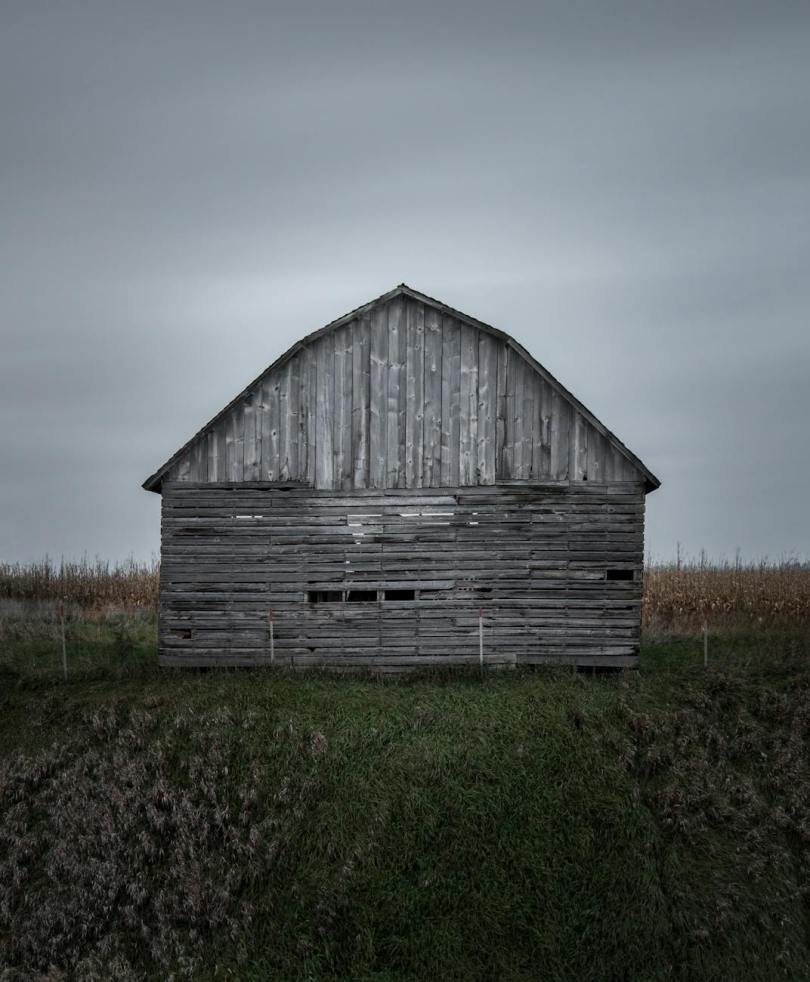
The old life rearranges itself around you like a table setting. Small suitcase upon childhood bed. The inhalation of familiar smells—wood stove, pine cleaner, remnants of bacon grease. Mother tending to the house, the steely corners of her starched dress. Father a phantom, a bearded shadow floating in and out of the barn, a clanging noise in the basement, wrench against furnace pipe. You find it unsettling, how easy it is to slip into the routine as if you never left.
You spend the first few days floating in a familiar, lukewarm sea, drifting from one side of the farm to the other, examining the place like a historical landmark: here’s the hayloft where you broke your leg; there’s the milk pail you were regularly forced to drink from as a child, its contents steaming in the cold barn. You’re sleeping badly, uncomfortable atop the ancient bed, the springs digging into your spine, the house rasping like a diseased lung in the night.
In the kitchen one morning, you see your mother bent over her box of recipes, a dusting of flour and sugar covering every surface, a yeasted tang in the air.
“Where’s father?” you ask, not sure why.
“In der Scheun,” she replies, a note of condescension dimpling her voice, her gaze as crisp as a bite of apple. You know she disapproves of English in the house. She always has. But you do it anyway.
“Du solst ihm hëlfe heit,” she adds as an afterthought as she disappears back into her recipes. Help him with what?
“Vielleicht später,” you mumble, absentmindedly thumbing a fingerprint in the dusting of flour on the breakfast table. You look at the pitcher of orange juice, wishing it were something caffeinated.
“What are you making?” you ask, wanting to steer the conversation away from your cravings, from a life you cannot live right now.
“Altmodische Rezepte,” she says, and then adds “old-fashioned” for your sake. Identical smiles bloom on both your lips, a mysterious energy dancing in the quiet room. You suddenly feel at ease, the hill of your shoulders leveling off, the apprehension you’ve felt since arriving melting away. You start to wonder why, but realize it’s so much easier to let go, to fall backwards into the passed down recipes. You feel lighter than you have since arriving.
“Du musst ebs habbe,” she says warmly, like the mother you remember, always ready to give, give, give. You nod in agreement.
For what seems like hours you sit there and watch her fill large bowls with fresh cream, whipping them into clouds like miniature reproductions of heaven. She takes toothpicks and sticks them into bottles of food coloring, runs them through each bowl until everything is the color of jellybeans. She piles sugar into a saucepan, heating it until it transforms to a thin caramel. Every so often she asks you to add a log to sustain the oven. These are the only words you share, and you feel yourself drifting into a sedative state, stashed away inside a swirling, confectionary memory.
“Esscht,” she finally says. A loud ticking of the grandfather clock in the living room reminds you of time as a concept. You wake to see her swimming above you, carrying a large platter filled with smaller bowls of her creations. She points to each in turn, naming them in English. Divinity, she says, pointing to snow-white mounds of candy. Ambrosia Salad, a potpourri of cream and canned fruit, topped with a maraschino cherry. Blackberry Toss, she nudges a bowl of lavender trifle. Martha’s Slaw. Corned Casserole. Whup Grange. Bird’s Nests. A smorgasbord of the Midwest laid before you, not-salads with salad in the name, casseroles, creams and candies and confections to dissolve the teeth. She sits down across from you, holding out a spoon.
Each time you remove the spoon from your mouth, you give an enthusiastic Mmm. You do feel ravenous in that moment, like it’s been years and years since you’ve tasted food, like you live on a diet of sand and soil outside the community. But after a while, something changes, the spoon suddenly heavy, your mother’s finger urging you to start the next dish now something like a dare, the sharp point of a knife.
Noch e wennich. Eat more, she says without saying, an urgency, a cloying sweetness in the eyes, the finger shaking slightly, vibrating as if mechanized.
And you keep eating through second helpings, washing things down with a glass of fresh milk, the top cream leaving a waxy finish on your lips. You cannot stop, no matter how much you desire to upturn the platter of food, to splatter the kitchen walls with the various colors of your mother’s culinary rainbow. You finish every bite she sets before you, scraping the bowls and plates clean with your fingers, the leaden spoon long since abandoned. You feel your stomach pressing against the thick fabric of your collared shirt, the black suspenders straining.
“Gut gemacht. Now verbrenn die Abfall,” she says to you, pointing toward the rubbish bin looking pleased as she wipes the counter back to its normal luster. Not a suggestion, but a demand. A repayment. How could you forget the rules of the house?
“Sicherlich,” you reply, pulling the bulging sack out of the can and walking toward the back door, throwing on one of the pairs of boots lined like soldiers along the door.
You notice a something shining on the road through the waves of heat still coming off the morning’s burn, right at the turn that leads up to the farmhouse. You throw the trash into the barrel and step to one side to get a better look, but it’s no use; whatever’s there is too small, too far away. You plod across the property in your father’s oversized boots like a magpie, curiosity overtaking you.
As you approach, you see the jagged teeth of a dead possum, the seams of its body split apart, a mess of blood and entrails spilling from the empty cavity. But that is not all. Mixed in with the carnage is an assortment of colors, a bubblegum pink mound, still pulsating, kissed with white, marshmallowy flecks, ribbons of turquoise confection like an interrupted pull of saltwater taffy, a dazzling puddle of gold sprinkles.
For one long moment, you feel as though you are looking into a mirror, your tongue lolling out of your mouth on the sunbaked highway, your stomach emptied of its contents, your kaleidoscopic lunch of dyed mayonnaise and cream. You turn back toward the house and retch, fulfilling the prophecy, the sun, a bright egg yolk muted behind the merengue clouds, throwing your dazzling sick into sharp relief as it pours from you. In the window, your mother’s silhouette, watching you turn inside out.
 Trent McMahon